The Semantic Blindspot: Why Bigger Models Won't Save Your AI Agent Without Ontology
Part 1 of 3 in the Enterprise Ontology series.
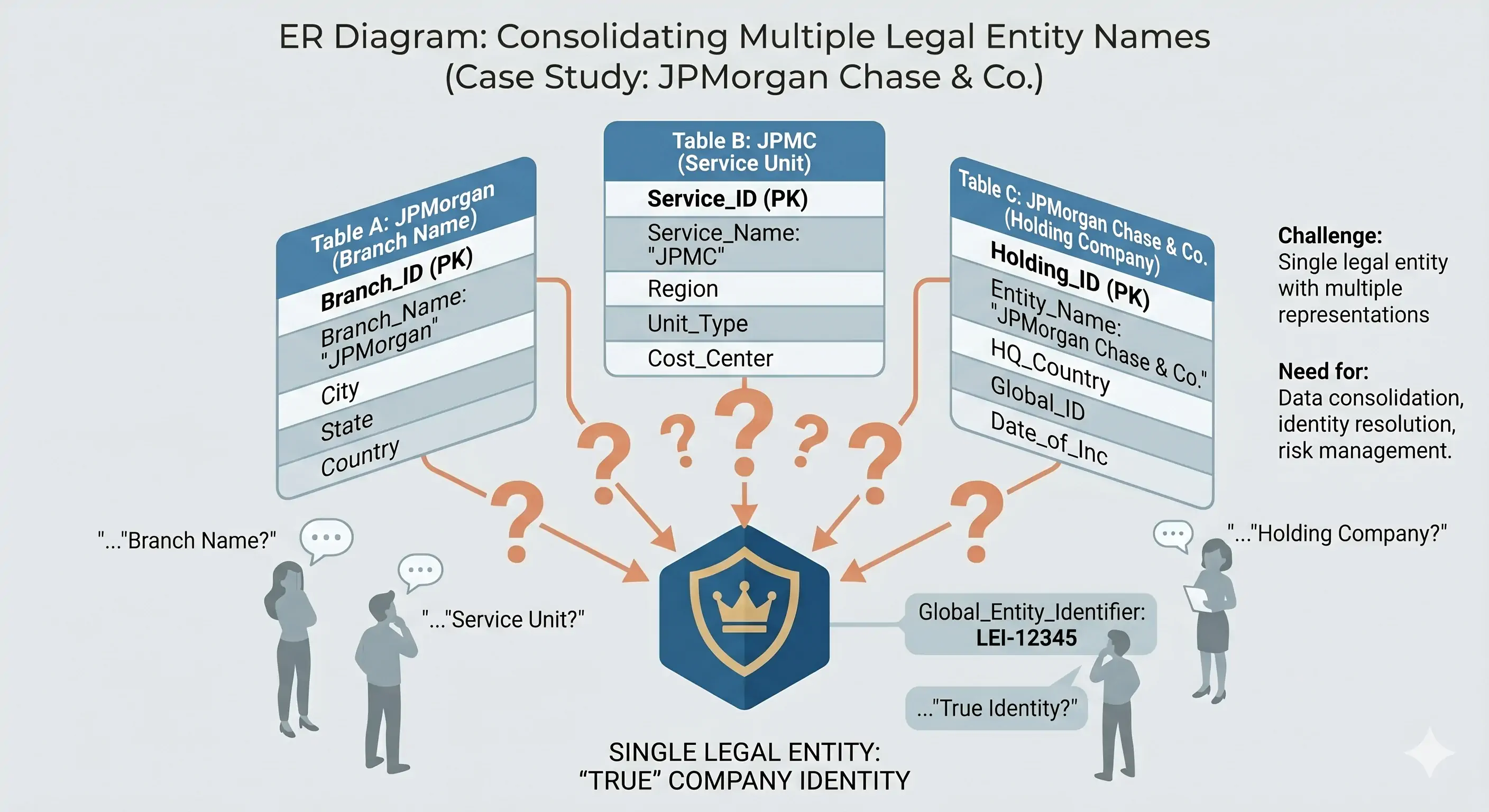
In a typical bank's risk system, "JPMorgan," "JPMC," and "JPMorgan Chase & Co." live in three different tables. A human analyst spends a day reconciling them. An AI agent sees an ontology gap and reports the wrong exposure number.
This is not a retrieval problem. The data is right there. It is not a model problem. The next frontier model will fail the same way the current one does. It is a semantic problem: the agent does not know that those three strings refer to the same business object.
This is the failure mode killing enterprise AI pilots. And it is the one no one is benchmarking.
The production paradox
Most enterprise AI demos work. Most enterprise AI pilots stall. The gap between the two is wider than it looks.
The usual diagnoses are real but incomplete: tool-calling design, permissioning, stale data, evaluation gaps, prompt injection, observability, context limits, escalation paths. Teams have closed some of these gaps.
But there is another class of failure that no model upgrade will fix. It happens when an agent misinterprets a core business concept whose meaning is precise, contextual, and enterprise-specific.
The agent understands the word. It does not understand the business reality behind the word.
Call it the semantic blindspot.
What a semantic blindspot looks like
Pick any of these and ask three people in your company to answer:
- Is a "customer" the person using the product, the account paying the bill, the contract holder, or the household sharing the service?
- Does "revenue" mean booked, recognized, recurring, net, or forecasted?
- Is a "shipment delay" measured from warehouse departure, carrier pickup, customs clearance, or customer delivery?
- Should a subsidiary's exposure roll up to the parent, stay independent, or both?
You will get different answers from finance, sales, and operations. You will get different answers from the same team six months apart. The systems of record reflect those disagreements as inconsistent fields, overloaded columns, and tribal lookup logic.
Humans paper over the gaps. They know that "customer" in the Customer Relationship Management (CRM) system means the account paying the bill. In the support system, it means the person who opened the ticket. They route around the ambiguity with email threads and Slack messages.
Agents have no such workaround. They take the word at face value, pull whatever record matches, and act.
These are not vocabulary problems. They are business logic problems.
This class of failure doesn't crash, it bleeds
A model hallucination is loud. A semantic blindspot is quiet.
The agent returns a plausible answer based on the wrong object. Downstream systems accept the input, reports get generated, decisions get made. The damage shows up weeks later as:
- inconsistent decisions across regions or teams
- false-positive alerts that erode trust in the system
- duplicated workflows where two agents act on what they think are different entities
- compliance exceptions caught only at audit
- manual reconciliation work that grows instead of shrinks
- remediation costs no one budgets for, because no one expected them
This is why "let's just try a bigger model" does not help. The model is not confused. It is doing exactly what its inputs imply. The inputs are the problem.
Industry surveys put the AI pilot-to-production failure rate at 70 to 80%. The blame usually lands on "data quality." Look closer. A large share is semantic. The data is not always wrong. The data means different things in different systems, and no one wrote that down for the agent.
The missing layer
More retrieval doesn't fix it. Retrieval-Augmented Generation can hand the agent every policy document the company owns, and the agent still won't know whether two records refer to the same legal entity. A sharper prompt doesn't fix it either, because you cannot prompt your way around an underspecified business concept.
What fixes it is a formal model of the business itself: what the meaningful objects are, how they relate, and what rules govern them. A shared, machine-understandable model that agents reason against before they act.
That model has a name: an ontology.
What ontology means here
Ontology is an overloaded word. In enterprise AI, use the practical definition.
An ontology is a shared, machine-understandable model of the meaningful things in a business, the relationships between them, and the rules that govern them.
It is not a glossary. A glossary explains a term to a human.
It is not a database schema. A schema tells you which columns exist.
It is not a data catalog. A catalog tells you where data lives.
An ontology goes one layer deeper. It tells the machine what kind of thing a record represents, how that thing relates to other things, and which constraints apply.
A useful ontology answers three questions:
- What are the meaningful business objects?
- How do those objects relate?
- What rules govern those objects?
That distinction matters for agents. Data access alone isn't enough; agents need a business object model to reason over before they act.
In Part 2, I will break down where ontology fits in the agent stack and why it sits in a different layer than retrieval, not in competition with it. The mental model: data tells you the current state, ontology tells you what that state means, action layers decide what the agent is allowed to do about it.
If your agents are answering questions today and you are considering letting them act tomorrow, this is the layer you cannot skip.